
Studio News
Pitch Decks for Dummies vol.2
Allie Veneruso ·
Studio News
We have a joke at MVGIE about finding this mythical person who’s just roaming around, looking for us, bringing along a suitcase full of money. It’s just an imaginary thing to entertain and motivate us, but it’s not that different from reality.
When you’re a dev looking for a publisher or investor, you really are just navigating a sea of people until you find that one sponsor who’s right for you, and who you are right for.
I remember my first ever pitch. It was my first year of uni, and as a final assessment I had to do a mock pitch for the game I’d worked on across different modules over the past months. Back then, I didn’t even know what “pitch” meant, especially since the word has no direct translation in Italian.
Every time we had to pitch something in uni, we were never given a clear guide on what should go into a presentation. Some teachers had specific preferences, but it all felt quite blurry and dependent on the subject. Even during my first internship (same studio as Alex and Phillip, though I was in a different team), we focused more on explaining gameplay mechanics than actually trying to sell an idea.
No, “selling” your idea sounds bad. “Looking for someone who’ll share your enthusiasm” sounds better, though maybe a bit idealistic. So, a middle ground: finding someone who thinks your idea and plan are good enough to become engaging to players, and therefore profitable to them.
Ultimately, it’s not all about the money, but without it, making a game gets a hell of a lot harder. For some ideas, impossible, even. You know that already, otherwise you wouldn’t be reading a post about pitching.
So, let’s get to the vegetarian meat of it (no animals were harmed in the making of this blog).
As I was saying, no one gave us proper guidelines at first. I assumed that was just because university tends to be more academic than practical. So when we joined the Tranzfuser programme and were asked to make a pitch as you would to a publisher, I thought: finally, we’ll get the guidelines.
And we did get a lot of useful information, especially during a meeting with an industry expert who evaluates pitches as their full-time job. Alongside helping us figure out a suitable budget, they also guided us on the structure of the deck.
The first “guidelines” we got looked something like this: an opening slide, a gameplay trailer, a brief explanation of the game, a core loop, a few slides for details, a USP (but don’t call it that), what we’d done so far, what we planned to do, the team, comparative analysis, what we needed from publishers, a budget, a summary, and a thank you slide.
So, that’s it, right?
In Tim Curry’s voice: “I’m terribly sorry, sir, but I’m afraid you’re mistaken.”
Not long after finishing Tranzfuser and founding MVGIE, we made a pitch deck for our first game idea following those instructions almost religiously, as if there were a fixed template and we had finally been let in on the secret.
We sent it to someone in the industry just to get feedback, and feedback we got.
Our deck was way too long (thirty-three slides… were we insane?), the feedback said ten slides should be the absolute max. We were told to grab attention instantly (so start with a trailer), make the comparative analysis more about our game and limit it to two others, include more artwork, add a marketing plan, and clearly explain what we meant when we asked for things like marketing, QA, or porting.
It was a bit demoralising, but the email ended on a positive note: “Overall a good first draft… keep cutting down, keep asking people (other than family and friends) how it’s landing. Keep going and DON’T GIVE UP!”
We thought we were already past “first draft” territory, but we took the encouragement. The problem is, we made the same mistake again: we treated that feedback as a new set of rules.
We ignored two key pieces of advice: keep asking people, and remember that different audiences might need different decks. If we’d focused more on that, we might have been better prepared for what came next.
Our next big learning moment came during the Games London Game Changer programme. It was the first time we were in an environment where pitching was the main focus. The programme covered all sorts of things, but we also had dedicated pitching workshops and a final finance market event.
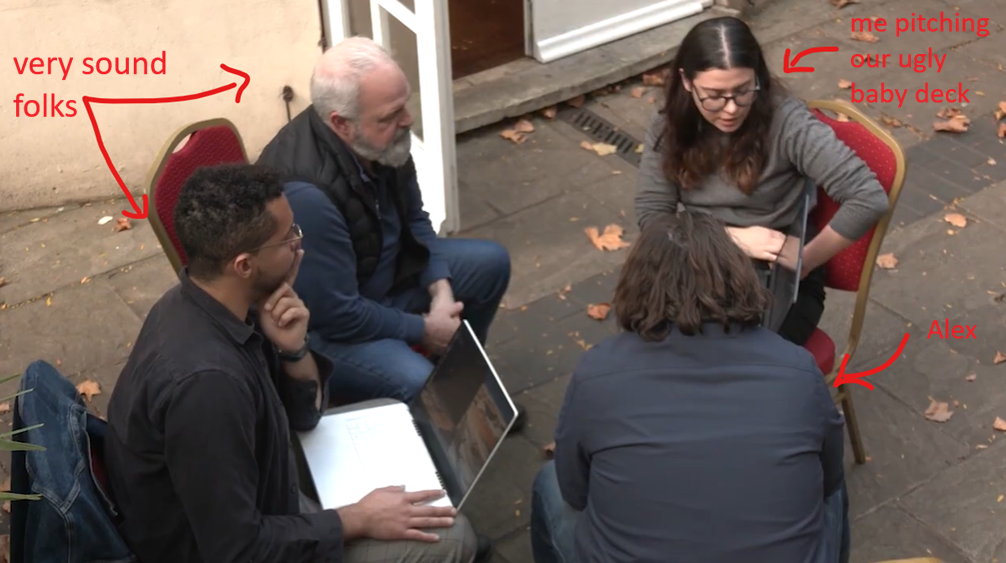
^ MVGIE at Game Changer 2024.
What really made the difference was the frequency of feedback. Instead of hearing from one person every few months, we were suddenly pitching the same deck to a dozen people in a single day.
Again, a lot of takeaways. The comparative analysis should focus on recently released games in a similar market position. Always specify target platforms for release, and internally account for why you’re choosing those platforms and what the porting needs are, as they’ll shape your timeline and budget.
Yet, with a lot of takeaways came a lot of contradictions.
We received completely different opinions on almost everything. Budget expectations ranged wildly, from people saying anything under 500k wouldn’t be interesting, to others insisting we should stay under 80k. Some said a margin wasn’t necessary, while others told us we needed at least 30% (for the record, you absolutely do need a margin).
We were told to remove the gameplay trailer slide because it wastes valuable attention time, even though we’d originally been told it was essential. Some suggested putting the team slide first because we’re not well known, others said to leave it until the end. Some emphasised the importance of showing gameplay and visuals, while others warned that rough visuals could misrepresent the final product.
Some feedback even directly contradicted what we’d been told years earlier, like whether or not to explain what marketing and QA would involve, “a publisher who’s used to offering that will know what you mean, no need to spend too long on it”. The most intense contradiction was probably about using pie charts for the budget slide. It seems that people feel very strongly about whether they want it in or not, so good luck making the right choice there!
And occasionally, the feedback just… wasn’t for us. That happens too. You won’t always be talking to the right person for your project. The most memorable example was someone suggesting we use AI to generate branching dialogue… to Alex, our writer. I’m still upset I didn’t get a picture of his face.
At some point, it became clear: a fixed template does not exist (I totally won’t contradict this by giving you a template at the end of the post, definitely not).
I don’t want to say there are no guidelines at all. There are definitely some things that come up again and again.
You do need to explain your game, your team, your budget, and your timeline. Most of the time, a comparative analysis slide is also expected.
But beyond that, things get flexible very quickly.
For example, some slides are more useful in a deck you send than in one you present live. If you’re presenting in person, a wall of text is a huge no. If you’re sending the deck, you’ll naturally need a bit more written context. The same applies to things like a dedicated USP slide.
Another thing to learn is about timelines. It’s usually better to avoid specific months and stick to something like “Month 1”, “Month 2”, and so on. Not only does that save you from constantly updating your slides, but it also accounts for the unpredictable gap between the first successful pitching, signing, and actually starting development (standard is six months, but it varies).
Length-wise, keeping your deck around ten slides is good practice, but it’s not a strict rule by any means, just don’t go overboard (looking at you, 33-slide deck). Between 7 and 15 slides is the sweet spot, unless you have a really good excuse for a different amount. For live pitches, aim for around five minutes. Most meetings last 10-20 minutes, and leaving time for questions is crucial. If you’re talking for ten minutes straight, it’s already too long. Use a stopwatch to practice getting the timing right.
One useful trick is to hint at non-essential information you’d be happy to share rather than fully explaining it. If they’re interested, they’ll ask once you’re done presenting. That way, you stay concise without losing depth.
You’ve probably heard this before with job applications: research the company and tailor your CV. Publishers and investors are no different.
Different publishers operate in different budget ranges. Some will only look at projects above a certain threshold, while others focus on smaller budgets. Some offer full support (marketing, QA, localisation, porting), while others only provide funding. If you’re going to a big event, they might even give this kind of information during the shortlisting phase, for example the Games Finance Market does that. However, you should still trust your better judgement and do some personal scrutiny.
It’s worth researching all of this before you pitch, so you can filter out bad fits. But you can also adapt your pitch slightly depending on who you’re talking to. Maybe you already have a back-up plan for marketing, so you can approach both a publisher who doesn’t provide it and one who does, and adjust your pitch accordingly.
That said, the core of your project shouldn’t change. You should always know what your game is and what you need. Tailoring is about how you present that information, not about reshaping the idea itself.
And of course, not every game is the same, so there can’t be a universal way to present one. A narrative-driven game might need more focus on story, while a mechanics-heavy one should prioritise gameplay. A unique concept might require more explanation than something more familiar.
The real question is: what does your audience need to know in order to understand your game and get excited about it?
If your pitch clearly answers the three WWHs - what the game is, why it should be developed by you, and how you’ll make it - then you’re on the right track. Everything else is just refinement.
For our current game alone, which we started less than ten months ago, we’ve already made around ten different versions of the deck. Even after settling on a solid base, we still tweak it for every event, funding application, or email we send. That’s just how it works.
If you promise you understood the point about adjusting your pitch to your needs, and you just need someplace to start, you can have a look at this pitch deck template.
One last universal guideline: always include your contact details on the final slide.
Just like I’ll leave mine here, in case anyone has questions about pitching. Hopefully these two posts were helpful, but honestly, there’s so much to say on this topic you could fill a whole bookshelf.
See youse next time,
Allie
Share this post